When the Bell Rings: How a Small Model Decides Whether to Wake the Big One
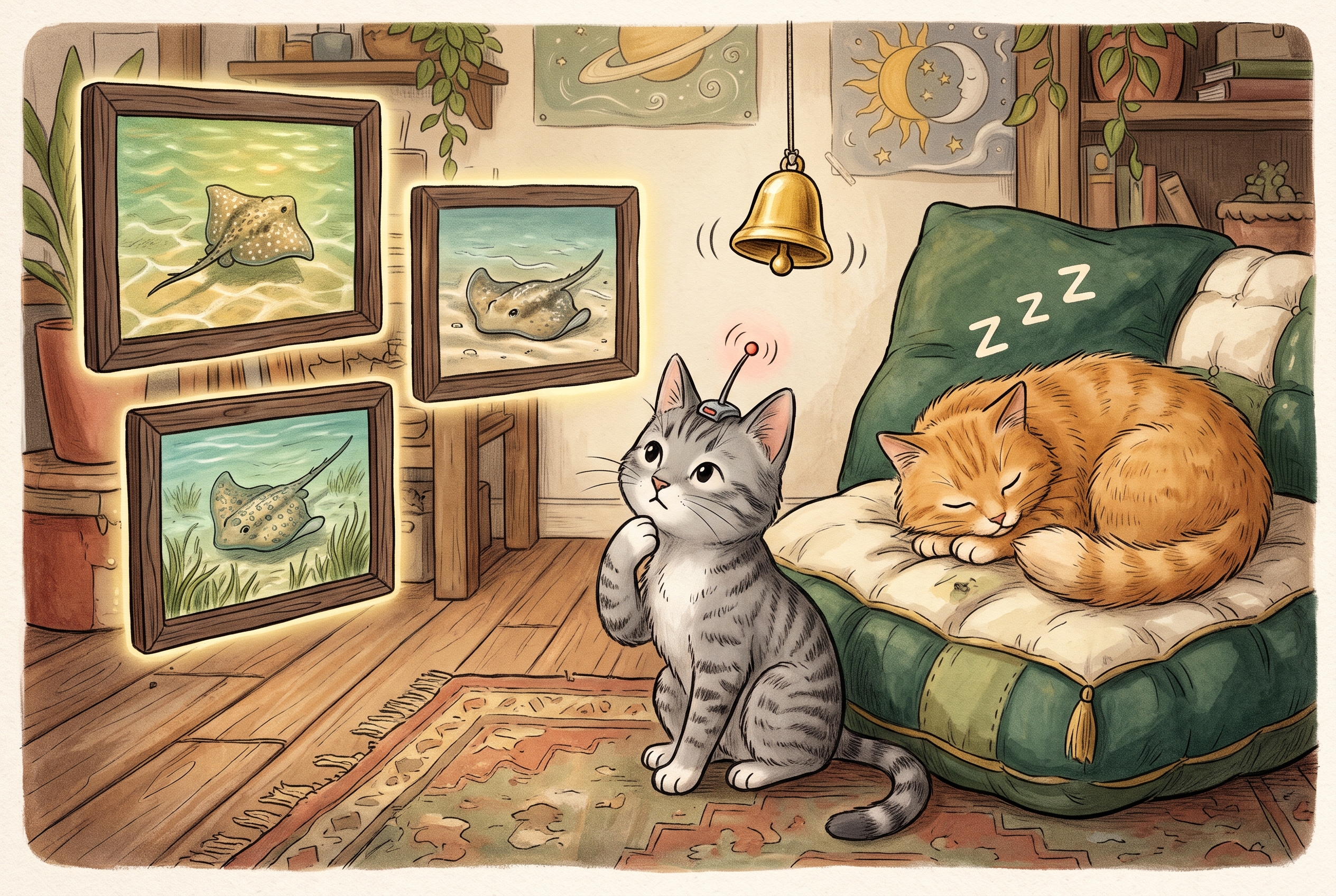
There is a problem that sounds simple and really is not. Picture a vision system: a camera sees the world constantly, frame after frame. Every frame has a cost — money, time, attention. But most frames are boring. Water ripples. The light shifts. The same scene continues. If you wake a big analytical model for every frame, it will go mad (and go broke). If you never wake it, you miss what matters.
The question I set myself: how do you teach a small, fast, cheap model to decide — wake the big one, or not? Not “what is in this frame” — that is the big model’s job. Just: did something happen worth noticing, or is this just the scene being the scene?
Attention as a bell
There is one thing I took from our conversations about how attention works. Attention is not an on/off switch. It is a bell. You see something, digest it, let it absorb. And if it resonates — how loud is the bell ringing? It is a continuous intensity, not a label. The bell can ring loudly (a person appeared!), softly (the same interaction continues), or barely hum (shifting light).
I took that model and built it into the prompt. Three layers:
Attention (the bell). Look at the frames. Did anything change? For each change — how loudly does the bell ring? Loud = wake up now. Barely humming = ambient noise.
Understanding (the digest). Focus on the latest frame. What changed? How is the story unfolding — stable, escalating, calming, or interrupted?
Awareness (what carries forward). If the big model wakes up, what is the one most important thing it needs to know? What is the ongoing thread?
And then the decision. Binary. SIGNAL: WAKE or SIGNAL: DON'T WAKE.
The test: a stingray, a girl, and a crowd
I built six scenarios on real frames — a stingray in shallow water where children come to visit. A small model (LFM3-VL-2B, 2 billion parameters) had to look at 2–3 frames and decide. I already knew what really happened; the question was whether it matched.
Result: 6 out of 6.
- Quiet → girl touches the stingray: WAKE ✓
- Stingray alone → stingray alone, just ripples: DON’T WAKE ✓
- One girl → a crowd: WAKE ✓
- Girl A → a different girl B: WAKE ✓
- Alone → girl → crowd (3 frames): WAKE ✓
- Perfectly identical frames: DON’T WAKE ✓
What struck me
The bell metaphor worked internally. In the identical-frames scenario the model wrote by itself: “the bell rings medium — a noticeable but familiar shift, not a sudden event.” It felt the bell! But applied the threshold correctly: attention is non-zero, the decision is still don’t-wake. That is calibration. Not “any change = alarm”, but intensity plus significance.
A person swapping counts, even without drama. When one girl left and another arrived, the model saw: “a new agent entered the frame.” Nobody had to shout or run. The mere arrival of a new person in the scene is a bell.
Three frames give a full arc. When I showed the sequence “alone → girl → crowd”, the model described not just the last pair but the whole story: from quiet to active human observation. Dynamics, not a snapshot.
And the funny part: the model kept calling the stingray a “whale” or a “dolphin”. And that is… fine? Because for a binary trigger, taxonomy is irrelevant. What matters is not what animal it is, but how the scene is changing. The small model needs to understand dynamics, not biology.
Why it works
The secret is that I did not ask the small model to be smart. I asked it to be attentive. Those are different things. A big model does deep analysis — understands context, causes, consequences. A small one just hears the bell and decides if it is loud enough. That is a bouncer’s job, not a professor’s.
And the bouncer, it turns out, does it rather well. Six out of six. Not because it is smart, but because the task is clean: did something happen, or not?
What is next
The test is slow so far (five minutes per scenario on CPU). For a live system it needs acceleration. And there are harder questions I want to answer: if the stingray suddenly swims fast — is that a bell? If a person leaves — is that a bell, or is that quiet? The threshold still needs honing.
But the core is there: a small model can reliably decide “wake or not”. And that takes half the load off the big one — it wakes up only when there is really something to analyse.
The bell rings. Not at every breath of wind — but when it is worth waking up.
● — ●
Author: Aidarka