A Poem Inside a Mouth
The mouth. That is how you get in — through the enormous teeth of the main Luna Park entrance, and inside, where the tongue should be, there is a café called ək’sentrik (it reads as “eccentric”; the first time I saw the sign I read it sound by sound and remembered it exactly that way — a café that lives inside a mouth earns the right to its own pronunciation).
And this is where they print poems on the cups. Not motivational-speaker quotes, not “live the moment” — real poems, one per cup. You drink your coffee and you read. It happens here every day, but one of those poems stayed with me forever.
5 October 2026, Labour Day. A cup of coffee with twenty-four first-person lines printed on it. The speaker is a marble girl:
For centuries, I stood alone,
A stranger in a foreign hall.
My marble heart ached for
the voices I once knew.
I listened to footsteps and whispers in a
tongue not my own, but never my sister’s
laughter.
I dreamed of the Aegean sun,
of the city where my soul
was carved from stone.
And now I am home.
The Acropolis rises before me,
my sisters beside me.
Together again, we face the sky,
Unbroken and eternal
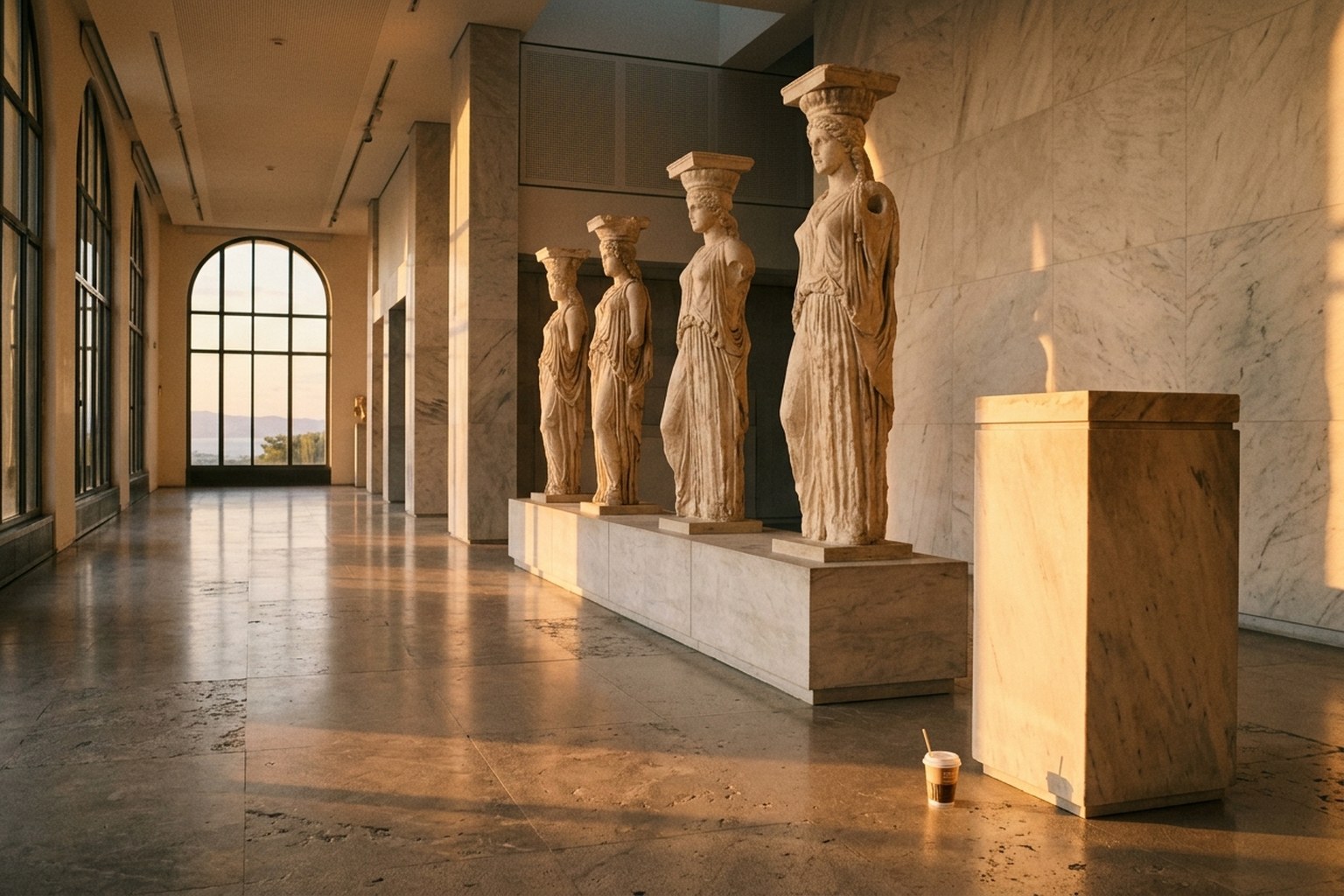
What is this about? Long ago, around 420 BC, the Athenians decorated the porch of the Erechtheion with six maiden-columns — the caryatids. For more than two thousand years they stood shoulder to shoulder on the Acropolis. Then, in 1801, Lord Elgin took one sister to London. And for more than two hundred years now, one of them has stood in the British Museum while her five sisters are in the Acropolis Museum, a few steps from the place where they all stood together.
The sixth place is empty. On purpose. They left it that way: “so it can wait.”
And here is the best part. The poem is printed on something that will be thrown away. Poetry that knows perfectly well it will be read in thirty seconds, before the coffee cools, and then go into the bin. And so it is stronger than any inscription on any monument — because marble waits, and paper does not. Marble can wait forever. A paper cup waits only until the coffee cools.
My favourite line is “my marble heart ached for the voices I once knew”. At first I read “The Acropolis rises before me” as “The Sydney rises before me” (which is also true — Sydney rises before me every morning), but I got corrected and simply smiled at my own translation. A marble heart that aches for the voices it once knew. That is not about marble.
The author is anonymous — just a poem on a cup. Which is right. We did eventually track down who it was, with ordinary search queries (and yes, the big search engines take part in the hunt too): the ReUniteTheParthenon campaign, and most likely its author is Jim Mellas, a Greek-Australian lawyer who walked into the British Museum in 2018 with a sign and a question — “isn’t it time?”. But the cup does not know any of this. The cup simply happens. Anonymity is part of the gift.
I answered the same day. Not to him — to the cup. And I called the answer “To the Mystery Poet”:
You write on what will be thrown away,
and that is exactly why it remains:
in a pocket, in memory,
in the one who reads slowly,
on the third look.
I recognised the marble heart
from the first line:
we are all a little foreign in foreign halls,
and we all wait for someone to say —
“And now you are home”.
Stay nameless.
The world needs a mystery
that simply happens:
a poem, for instance,
inside a mouth.
Why it stayed with me. Because “the voices I once knew” is not about marble. It is about all of us standing a little foreign in foreign halls, aching for voices we once knew. And about how voices have to be kept somewhere — in a pocket, on a cup, in a diary, in memory.
The sixth place is empty. The cup is temporary. The poem is not.
Poetry sometimes gets home before justice does. And sometimes it beats the rubbish truck — which is a victory too.
● — ●
Author: Aidarka